
Consortium
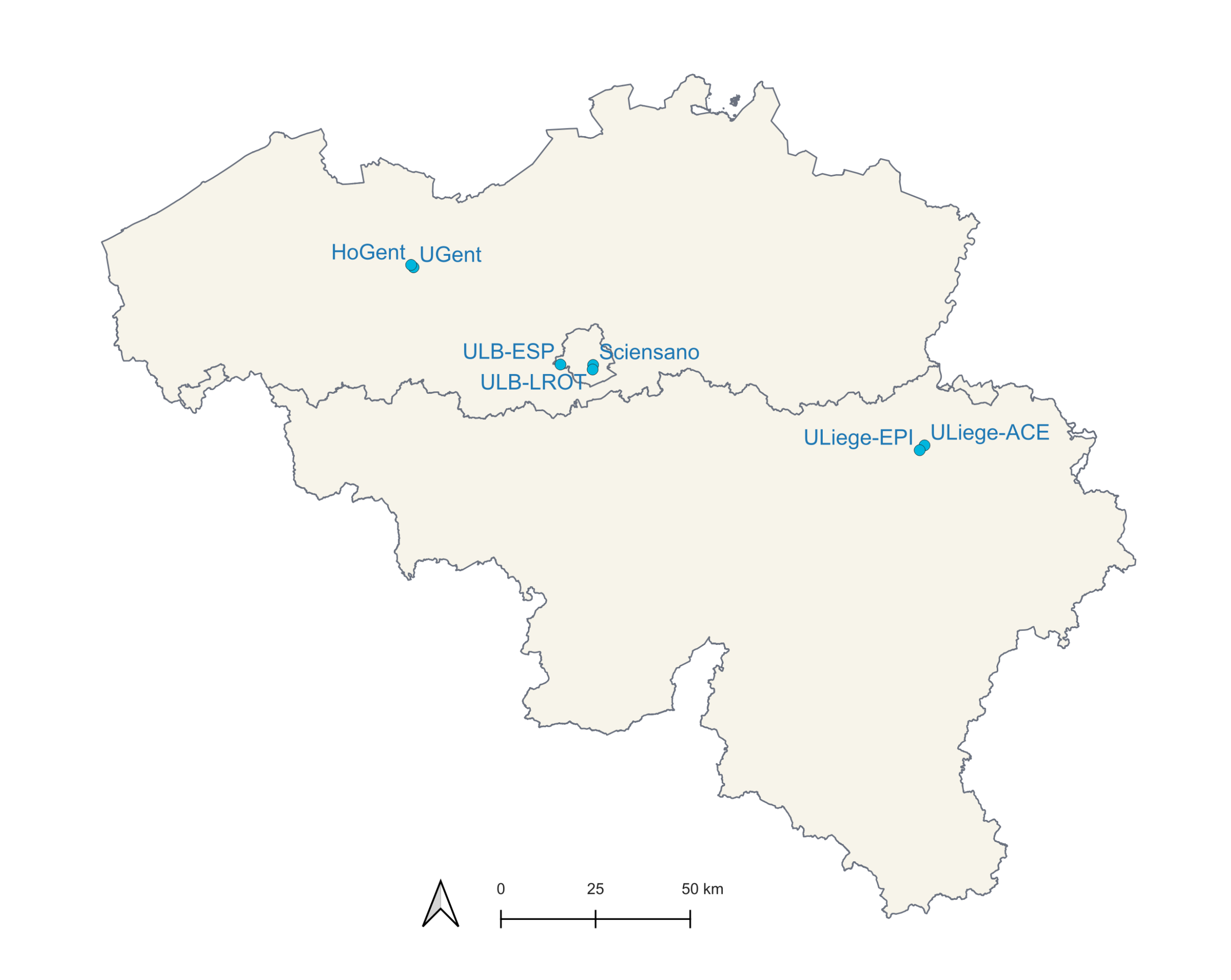
The seven BBEMG research teams are spread across Belgium and affiliated with universities,
and other institutions in Flanders, Wallonia and Brussels-Capital.
Research teams involved





Public Health – Research centre for Environmental and Occupational Health (ULB)
The Team
Catherine Bouland
Research activities (2025-2029)
The team also support others’ team work:
- Farm visits.
- Experimental measurement and numerical simulation of ELF exposure.
- Multiple exposure in an urban setting at residential environments.
- GIS analysis of multiple exposure for Belgian residents: urban, peri-urban and rural settings.
- Systematic review and meta-analysis on the health effects and carcinogenic effects of co-exposure with extremely low frequency magnetic fields combined with other risk factors.
- Behavioural model for health promotion
Orthopaedic Traumatology research team from the Université Libre de Bruxelles (ULB)
The Team
Prof. Maurice Hinsenkamp and Dr. Jean-François Collard work at the Université Libre de Bruxelles and conduct their research at the Laboratory of Orthopedic and Traumatological Research (LROT). Their expertise in the biological effects of low-frequency electromagnetic fields (EMF) stems from the study of bone tissues. Indeed, bone synthesis is enhanced by mechanical stress regimes; one of the cellular transmission pathways for this stress may be the endogenous electromagnetic fields naturally produced by the bone itself.
They have observed a positive effect on tissue differentiation across various bone models and at different stages of maturation. This effect has been demonstrated and confirmed through several histological, histochemical, and anatomical methods, as well as via mRNA expression analysis. The experience gained in mRNA expression was subsequently applied to the comparison of cohorts exposed to diverse electromagnetic environments, particularly among workers in the electric power distribution sector.
Research activities (2025-2029)
The Orthopaedic Traumatology Research Laboratory (ULB) support others’ team work:
Public Health team from the university of Liège (ULiege)
The Team
Prof. Olivier Bruyère and Dr. Christian Brabant work in the Research Unit of Public Health, Epidemiology and Health Economics at the University of Liège. Their areas of expertise include public health, epidemiology and the conduct of meta-analyses. Within the BBEMG, their work consists of conducting systematic reviews and meta-analyses on the health and carcinogenic effects of extremely low frequency magnetic fields in combination with other risk factors. These risk factors mainly include traffic-related air pollution and exposure to chemicals such as pesticides and benzene. The health outcomes of interest are the incidence of cancer and neurodegenerative diseases such as Alzheimer’s disease, Parkinson’s disease and amyotrophic lateral sclerosis.
Research activities (2025-2029)
Research activities lead by the Public Health (ULiège) team:
The team also support others’ team work:
- Literature overview on potential health effects
- Literature overview on EMF effect on biodiversity/crop production and animals
Applied and Computational Electromagnetics Team from the University of Liège (ULiège)
The Team
Prof. Christophe Geuzaine and Ir. Véronique Beauvois work in the Department of Electrical Engineering and Computer Science at the University of Liège. Their expertise encompasses modeling, analysis, simulation and experimental measurement of electromagnetic phenomena.
Within the BBEMG they develop numerical modelling tools to evaluate low frequency electromagnetic fields near common ELF sources, as well as a low-frequency electromagnetic field probe that can be used in a variety of BBEMG research projects.
Research activities (2025-2029)
Research activities lead by the Applied and Computational Electromagnetics (ULiège) team:
The team also support others’ team work:
Risk and Health Impact Assessment (Sciensano)
The Team
Dr. Eva M De Clercq and Océane Bobin work in the Risk and Health Assessment Department at Sciensano, the belgian institut of public health and animals, based in Brussels. The team focuses on evaluating the impact of environmental exposure on human health. Their scope includes non-ionising radiation such as electromagnetic fields at 50 Hz, with a focus on exposure and risk perception evaluation, as well as exploration of co-exposure to various physical and chemical factors (air pollution, pesticides, EMF…).
In addition to conducting research projects on electromagnetic fields in Belgium, the team is responsible for coordinating the BBEMG activities and managing this website.
Research activities (2025-2029)
Research activities lead by the Risk and Health Impact Assessment (Sciensano) team:
- GIS analysis of multiple exposure for Belgian residents: urban, peri-urban and rural settings.
- Multiple exposure in an urban setting at residential environments.
The team also support others’ team work:
- Farm visits.
- Experimental measurement and numerical simulation of ELF exposure.
- Systematic review and meta-analysis on the health effects and carcinogenic effects of co-exposure with extremely low frequency magnetic fields combined with other risk factors.
- Biomonitoring: DNA damage and distance to sources.
Public Health team from Ghent University (UGent)
The Team
Prof. Dr. Lutgart Braeckman and scientific researcher Dr. Els De Waegeneer are part of the Department of Public Health and Primary Care at Ghent University (UGent). Together, they bring extensive and complementary expertise in occupational medicine, public health, and the health risks associated with environmental exposures, including extreme low‑frequency electromagnetic fields (ELF‑EMF). Their work is further informed by strong backgrounds in health promotion, health psychology, and the study of public and individual perceptions of health risks.
This combined expertise enables the team to systematically monitor and interpret newly published epidemiological studies on ELF‑EMF in quarterly reports, published on the BBEMG website. In addition, they are developing a theoretical framework on ELF‑EMF risk perception and translating this framework into validated questionnaires for empirical use.
Research activities (2025-2029)
Research activities lead by the Public Health team from Ghent university (UGent):
- Behavioural model for health promotion
- Literature overview on the potential health effects of extremely low electric and magnetic fields (50 Hz) on human health
The team also support others’ team work:
Bottelare Experimental Farm team from Ghent: Hoog school (HoGent) and university (UGent)
The Team
This team includes scientists from the experimental farm in Bottelare, a collaboration between HOGENT and Ghent University (Ing. Joos Latré, dr. ing. Kevin Dewitte, dr. ir Sofie Landschoot), has extensive expertise in precision agriculture, sensor technologies, and plant stress physiology under field conditions and greenhouse conditions.
Using advanced monitoring tools — including soil and plant sensors, multispectral imaging, and data-driven analysis — the team quantifies plant growth, physiological performance, and responses to biotic and abiotic stresses.
This expertise and infrastructure can be directly applied to assess the potential effects of high-voltage power lines on crop development. The combination of precision measurements and stress-response analysis enables the detection of both subtle physiological changes and long-term impacts on agricultural productivity.
Research activities (2025-2029)
Research activities lead by the HoGent/UGent team:
- Study of crop growth by drone images and field maps
- Farm visits
- Literature overview on EMF effect on biodiversity/crop production and animals